"Pictures of perfection, as you know, make me sick & wicked"

- Jane Austen
"Jane Austen is weirdly capable of keeping everybody busy. The moralists, the Eros-and-Agape people, the Marxists, the Freudians, the Jungians, the semioticians, the deconstructors - all find an adventure playground in six samey novels about middle-class provincials. And for every generation of critics, and readers, her fiction effortlessly renews itself."

- Martin Amis, in The New Yorker


Showing posts with label Jane Austen attributes. Show all posts

Friday, July 18, 2008

A Spot of Professional Jealousy

I've been reading this edition of James Edward Austen-Leigh's Memoir of Jane Austen while waiting patiently for a copy of the Oxford edition, which has a few extra bells and whistles.

And finally, we discover the reason for Mary Russell Mitford's nastiness about Jane Austen - she was jealous because Jane was a much better writer! James Edward Austen-Leigh writes:

I remember Miss Mitford's saying to me: 'I would almost cut off one of my hands, if it would enable me to write like your aunt with the other.'

Although poor Mr. Austen-Leigh was not at all happy when he read the "prettiest, silliest, most affected husband-hunting butterfly" comments made by Miss Mitford, and was driven to add a postscript to the first edition, denying that his esteemed aunt had been anything of the sort.

I suppose that might show up a difference between Georgian and Victorian sensibilities, and also between Victorian and modern-day sensibilities. Personally I find the description of Jane's lively, youthful personality far more attractive than the impression of a somewhat dour Jane many people have had - until Anne Hathaway's inspired portrayal turned that smartly on its head.

Wednesday, July 9, 2008

What They Said About Her: Henry Austen

This is what Jane's favourite brother Henry wrote about her, in his "Biographical Notice of the Author", which accompanied the posthumously published (1818) Northanger Abbey and Persuasion.

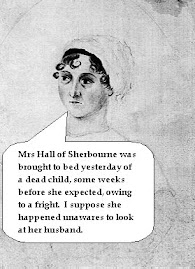
"Of personal attractions she possessed a considerable share. Her stature was that of true elegance. It could not have been increased without exceeding the middle height. Her carriage and deportment were quiet, yet graceful. Her features were separately good. Their assemblage produced an unrivalled expression of that cheerfulness, sensibility, and benevolence, which were her real characteristics. Her complexion was of the finest texture. It might with truth be said, that her eloquent blood spoke through her modest cheek. Her voice was extremely sweet. She delivered herself with fluency and precision. Indeed she was formed for elegant and rational society, excelling in conversation as much as in composition."

It has been noted that part of Henry's description - "her eloquent blood spoke through her modest cheek" - owes a debt to the poet John Donne, and consequently to Henry Fielding, who employed the same passage in Tom Jones (see my earlier post on this blog: Jane Austen & "Sophia Sentiment").

However, in the same Biographical Notice, Henry (at left) also avows that his sister had her reservations about Fielding. This latter assertion needs to be taken with a large grain of salt, considering the references in Jane's letters and the themes and character names used by her that also appear in Tom Jones. (A few of these have been pointed out by Jon Spence in Becoming Jane Austen, although a diligent reader will discover plenty more that he did not specifically note.)

Re-reading the famous Tom Lefroy white coat reference will reveal that the similarity to Jones is one envisaged by Jane Austen, not one that Lefroy himself professed or was necessarily aware of. "He is a very great admirer of Tom Jones, and therefore wears the same coloured clothes, I imagine, which he did when he was wounded." (Jane to Cassandra, 9 January 1796, emphasis in bold added).


Henry Austen's tribute to his deceased sister can therefore be considered the first of many attempts by her relatives to whitewash her image, whereby the sharp and witty Jane Austen becomes transformed into that sanctimonious creature, Saint Jane. Personally, this blogger much prefers the Jane whose halo is just ever so slightly askew!

Monday, July 7, 2008

What They Said About Her: Sir Edgerton Brydges

Samuel Egerton Brydges was Mrs Lefroy's brother, and lived at the Deane parsonage when Jane was young, prior to the Lloyd family moving there. Brydges later left the district, and from then on had little contact with Jane Austen, so can be counted on as an objective observer as any about her physical appearance.

"I remember Jane Austen the novelist... she was fair and handsome, slight and elegant, with cheeks a little too full. The last time I think I saw her was at Ramsgate in 1803: Perhaps she was then about twenty-seven years old."


From Bridges' Autobiography, published in 1834, and cited by Jon Spence in Becoming Jane Austen.

What They Said About Her: Mary Russell Mitford

Mary Russell Mitford (pictured, aged three) who herself knew a thing or two about writing a sharp and pointed letter, had this to say about the young Jane Austen and her physical appearance. The report is based on the observations of her mother, who had lived in the Steventon neighbourhood when Jane was growing up.

"Mama says she was then the prettiest, silliest, most affected, husband-hunting butterfly she ever remembers."

MRM goes on to add, in a bravura performance of downright maliciousness, that Jane had by then (1815):

"stiffened into the most perpendicular, precise, taciturn piece of 'single blessedness' that ever existed" and until Pride and Prejudice came out, "she was no more regarded in society than a poker or a fire screen or any other thin, upright piece of wood or iron that fills its corner in peace and quiet. The case is very different now; she is still a poker, but a poker of whom everyone is afraid."

Phew!

Wednesday, June 11, 2008

Jane Austen & "Sophia Sentiment"

On the posthumous publication of Persuasion and Northanger Abbey, Jane’s favourite brother Henry Austen described her physical appearance thus: “It might with truth be said, that her eloquent blood spoke through her modest cheek.” As Marghanita Laski points out, this is an incredibly pompous-sounding tribute - until we realise that these same words, originally from the poet John Donne, are quoted by Henry Fielding in Tom Jones to describe Sophia Western, who finally marries Jones - “Her pure and eloquent blood spoke in her cheeks”.[1]

Furthermore, Sophia Western’s complexion “had rather more of the lily than the rose; but when exercise, or modesty [emphasis added] increased her natural colour, no vermilion could equal it.” Sophia’s eyes were very dark and her black hair was “so luxuriant that it reached her middle, before she cut it to comply with modern fashion”. Louisa Austen’s description of her aunt Jane is as follows: “large dark eyes and a brilliant complexion, and long, long black hair down to her knees”[2]

From here, we may need to take another look at the “Sophia Sentiment” who wrote to James Austen’s publication The Loiterer on 28 March 1789. Some critics have already suggested that “Sophia Sentiment” was Jane Austen. Claire Tomalin does not, on the grounds that “Miss Sentiment” deplores women’s taste in literature. However, soon after this, Jane Austen uses Sophia for the heroine’s name in her satire Love and Freindship, [sic] attacking the excesses of the romantic novel, a favourite Austen theme. Tomalin suggests that repeated use of the name Sophia may have been a running family joke.[3] If this is the case, which seems likely, it is not hard to imagine where the joke originated.

Notes

[1] Marghanita Laski: Jane Austen & Her World; Henry Fielding, Tom Jones Book IV, Chapter II; John Donne (1572-1631) “Of the Progress of the Soul: the Second Anniversary” (notes to Tom Jones, Oxford University Press edition).
[2] Henry Fielding, Tom Jones Book IV, Chapter II;.Claire Tomalin, Jane Austen: A Life pp 108 & 311
[3] Claire Tomalin, pp 63 & 303-4.