"Pictures of perfection, as you know, make me sick & wicked"

- Jane Austen
"Jane Austen is weirdly capable of keeping everybody busy. The moralists, the Eros-and-Agape people, the Marxists, the Freudians, the Jungians, the semioticians, the deconstructors - all find an adventure playground in six samey novels about middle-class provincials. And for every generation of critics, and readers, her fiction effortlessly renews itself."

- Martin Amis, in The New Yorker


Showing posts with label Persuasion. Show all posts

Monday, August 4, 2008

Austen Autobiographical? "Persuasion"

From Chapter 1 of Persuasion

"ELLIOT OF KELLYNCH-HALL.
"Walter Elliot, born March 1, 1760, married, July 15, 1784, Elizabeth, daughter of James Stevenson, Esq. of South Park, in the county of Gloucester; by which lady (who died 1800) he has issue Elizabeth, born June 1, 1785; Anne, born August 9, 1787; a still-born son, Nov. 5, 1789; Mary, born Nov. 20, 1791."

Precisely such had the paragraph originally stood from the printer's hands; but Sir Walter had improved it by adding, for the information of himself and his family, these words, after the date of Mary's birth -- "Married, December 16, 1810, Charles, son and heir of Charles Musgrove, Esq. of Uppercross, in the county of Somerset," and by inserting most accurately the day of the month on which he had lost his wife.


So Anne Elliot's sister Mary was married on Jane Austen's birthday, which also happened to be the date of Mrs Lefroy's death (Tom's aunt). The Elliots' mother's maiden name was Stevenson, not spelled with a "ph", so it reminds us irresistibly of the village of Steventon, where Jane grew up. Jane also seems to have mined her mother's Leigh and Perrot ancestry in using the name Musgrove, although the actual surname was Musgrave (one of Jane's godparents was Mrs Musgrave).

However, the most interesting thing here is that the stillborn Elliot son was born on the same date that Tom Lefroy's brother Anthony married Elizabeth Wilkin. Son Elliot was born 5 November 1789, Anthony Lefroy was married on 5 November 1798. Coincidence? Given Jane's obsession with dates in both her letters and her fiction, and that she got news of other Lefroy marriages - "the third Miss Irish Lefroy" [Jane to Cassandra, 18 December, 1798] - I very much doubt it.

Wednesday, July 9, 2008

What They Said About Her: Henry Austen

This is what Jane's favourite brother Henry wrote about her, in his "Biographical Notice of the Author", which accompanied the posthumously published (1818) Northanger Abbey and Persuasion.

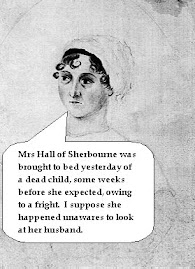
"Of personal attractions she possessed a considerable share. Her stature was that of true elegance. It could not have been increased without exceeding the middle height. Her carriage and deportment were quiet, yet graceful. Her features were separately good. Their assemblage produced an unrivalled expression of that cheerfulness, sensibility, and benevolence, which were her real characteristics. Her complexion was of the finest texture. It might with truth be said, that her eloquent blood spoke through her modest cheek. Her voice was extremely sweet. She delivered herself with fluency and precision. Indeed she was formed for elegant and rational society, excelling in conversation as much as in composition."

It has been noted that part of Henry's description - "her eloquent blood spoke through her modest cheek" - owes a debt to the poet John Donne, and consequently to Henry Fielding, who employed the same passage in Tom Jones (see my earlier post on this blog: Jane Austen & "Sophia Sentiment").

However, in the same Biographical Notice, Henry (at left) also avows that his sister had her reservations about Fielding. This latter assertion needs to be taken with a large grain of salt, considering the references in Jane's letters and the themes and character names used by her that also appear in Tom Jones. (A few of these have been pointed out by Jon Spence in Becoming Jane Austen, although a diligent reader will discover plenty more that he did not specifically note.)

Re-reading the famous Tom Lefroy white coat reference will reveal that the similarity to Jones is one envisaged by Jane Austen, not one that Lefroy himself professed or was necessarily aware of. "He is a very great admirer of Tom Jones, and therefore wears the same coloured clothes, I imagine, which he did when he was wounded." (Jane to Cassandra, 9 January 1796, emphasis in bold added).


Henry Austen's tribute to his deceased sister can therefore be considered the first of many attempts by her relatives to whitewash her image, whereby the sharp and witty Jane Austen becomes transformed into that sanctimonious creature, Saint Jane. Personally, this blogger much prefers the Jane whose halo is just ever so slightly askew!

Friday, June 20, 2008

More Austen movie adaptations

Good old Aunty ABC is continuing to screen a whole series of British Jane Austen movie adaptations, some old and some new, although sometimes one is reminded of the advice, which I think was in an article somewhere on the Republic of Pemberley (or perhaps it was JASNA?) - when trying to do an Austen adaptation, there is one main rule - DON'T!!

And so a couple of weeks ago, we saw Persuasion, which on the whole wasn't bad, although Rupert Penry-Jones was much too fair of complexion to be playing a weather-beaten navy Captain, and the whole thing was all a tad Gothic in tone. Anne Elliot's nervy, hypochondriac sister was an absolute delight, however.

Last week, we saw the latest (2007) version of Northanger Abbey, which to my taste was nowhere near Gothic enough, or at least not as Gothic as the 1986 BBC production. However, the actor who played John Thorpe was suitably villainous.

If only we could extract bits of one adaptation and merge them with bits of another, perhaps we might get an adaptation that approaches satisfactory. The BBC's TV series of Pride and Prejudice still seems to be the benchmark for Austen adaptations (that is to say, the "straight" ones that follow the novels more or less faithfully).