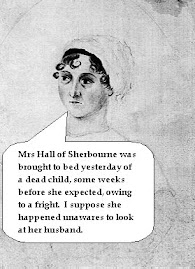
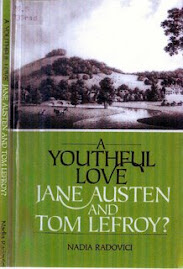
"Pictures of perfection, as you know, make me sick & wicked"

- Jane Austen
"Jane Austen is weirdly capable of keeping everybody busy. The moralists, the Eros-and-Agape people, the Marxists, the Freudians, the Jungians, the semioticians, the deconstructors - all find an adventure playground in six samey novels about middle-class provincials. And for every generation of critics, and readers, her fiction effortlessly renews itself."

- Martin Amis, in The New Yorker


Showing posts with label Tom Lefroy. Show all posts

Monday, August 4, 2008

Austen Autobiographical? "Persuasion"

From Chapter 1 of Persuasion

"ELLIOT OF KELLYNCH-HALL.
"Walter Elliot, born March 1, 1760, married, July 15, 1784, Elizabeth, daughter of James Stevenson, Esq. of South Park, in the county of Gloucester; by which lady (who died 1800) he has issue Elizabeth, born June 1, 1785; Anne, born August 9, 1787; a still-born son, Nov. 5, 1789; Mary, born Nov. 20, 1791."

Precisely such had the paragraph originally stood from the printer's hands; but Sir Walter had improved it by adding, for the information of himself and his family, these words, after the date of Mary's birth -- "Married, December 16, 1810, Charles, son and heir of Charles Musgrove, Esq. of Uppercross, in the county of Somerset," and by inserting most accurately the day of the month on which he had lost his wife.


So Anne Elliot's sister Mary was married on Jane Austen's birthday, which also happened to be the date of Mrs Lefroy's death (Tom's aunt). The Elliots' mother's maiden name was Stevenson, not spelled with a "ph", so it reminds us irresistibly of the village of Steventon, where Jane grew up. Jane also seems to have mined her mother's Leigh and Perrot ancestry in using the name Musgrove, although the actual surname was Musgrave (one of Jane's godparents was Mrs Musgrave).

However, the most interesting thing here is that the stillborn Elliot son was born on the same date that Tom Lefroy's brother Anthony married Elizabeth Wilkin. Son Elliot was born 5 November 1789, Anthony Lefroy was married on 5 November 1798. Coincidence? Given Jane's obsession with dates in both her letters and her fiction, and that she got news of other Lefroy marriages - "the third Miss Irish Lefroy" [Jane to Cassandra, 18 December, 1798] - I very much doubt it.

Austen Autobiographical? "Emma"

Jane Austen, writing to Cassandra about Tom Lefroy, 9 January 1796:

You scold me so much in the nice long letter which I have this moment received from you, that I am almost afraid to tell you how my Irish friend and I behaved. Imagine to yourself everything most profligate and shocking in the way of dancing and sitting down together.


Emma Woodhouse, trying to decide whether she really is in love with Frank Churchill, and whether she can mention his name without embarrassing herself:

"Now, how am I going to introduce him? Am I unequal to speaking his name at once before all these people? Is it necessary for me to use any roundabout phrase? Your Yorkshire friend -- your correspondent in Yorkshire; -- that would be the way, I suppose, if I were very bad. No, I can pronounce his name without the smallest distress. I certainly get better and better. Now for it."


There is a further link, as Tom Lefroy's brother Anthony was based in York. See Tracking Tom Lefroy and His nephew at Becoming Jane Fansite for more information on the York branch of the Lefroy family.

Wednesday, July 30, 2008

Did Tom Lefroy Really Wear A White Coat?

Much has been made of Jane Austen's early love, Tom Lefroy, purportedly wearing a white coat in emulation of Henry Fielding's racy literary hero, Tom Jones. However, the only authority we have for this is Jane herself, who, as a mistress of the art of the double entendre, ought not always to be taken literally. In Jane's earliest surviving letter to Cassandra, we hear that Lefroy:


“has but one fault, which time will, I trust, entirely remove—it is that his morning coat is a great deal too light. He is a very great admirer of Tom Jones, and therefore wears the same coloured clothes, I imagine, as he did when he was wounded.”


In Fielding's novel, Tom Jones incurred his wound in a singular manner: he volunteered to enlist in an army regiment, and in a round of after-dinner toasting and merrymaking, one Ensign Northerton jested about the allegedly loose morals of Jones’ beloved Sophia Western: “Tom French of our regiment had both her and her aunt at Bath” - among several other such slurs on her character. This was too much for Jones, who sprang to her defence, accusing Northerton of being an impudent rascal, which promptly earned him a bottle of liquor hurled at his head. Northerton, it turns out, had heard no such thing of Sophia, but was merely retaliating for an earlier jest by Jones. [Tom Jones, Book VII, Chapter XII]

The point has already been made on this blog that it is likely that an Austen family tradition existed concerning Jane Austen's resemblance to Fielding's heroine, Sophia Western. In Tom Jones, the specific reference to the white coat occurs when Jones is recovering from his injury:


As soon as the sergeant was departed, Jones rose from his bed, and dressed himself entirely, putting on even his coat, which, as its colour was white, showed very visibly streams of blood which had flown down it.[Tom Jones Book VII, Chapter XIV].


Austen biographer Jon Spence has given us a further example of Fielding’s use of wounding as a metaphor for being in love. In what is an extremely convoluted plot, Jones engages in a duel with a Mr Fitzpatrick, who wrongly believes that Jones is consorting with his wife, who is in fact lusting after Jones. Jones nearly kills Fitzpatrick, and is subsequently visited in prison by a Mrs Waters.

Earlier in the novel Mrs Waters had gone to Bath in the company of various Irish gentlemen, including Fitzpatrick, who from then on successfully passed her off as his wife (Fitzpatrick’s real wife was the cousin of Sophia Western). Mrs Waters has also once been in love with Jones:


“It was some time before she discovered that the gentleman [Jones] who had given him [Fitzpatrick] this wound was the very same person from whom her heart had received a wound, which though not of a mortal kind, was yet so deep that it had left a considerable scar behind it.” [Tom Jones Book XVII Chapter IX]

However, judging by the remainder of her interaction with Jones, it is by no means certain that her heart has in fact recovered from its wound.


I have already commented in an earlier post that Tom Lefroy’s purported admiration of Tom Jones need not be taken as incontrovertible fact. Fielding was a known favourite with the Austens, who had previously put on family theatrical performances of at least one of his works (Tom Thumb).

Given the numerous references to characters and situations from Tom Jones throughout Jane Austen’s novels, it is just as likely that it was Jane Austen herself who admired Tom Jones, despite what her brother assured the public after her death, when it became incumbent on the family to start protecting her ladylike reputation. Jane's talk of the Toms Lefroy and Jones and their white coats may well have been was a coded reference for Cassandra’s eyes only.[1]

If so, it would have been by no means the only time that Jane Austen employed a literary reference as a metaphor for her own situation. In a later letter she explicitly likened being stuck at her brother’s house with no means to get home again, to the plight of Fanny Burney’s heroine Camilla, stuck in a summerhouse without a ladder to get out.

Note:
[1] Linda Robinson Walker suggested the idea of a coded reference, although I believe it is more sophisticated than the one she puts forward. Jon Spence (Becoming Jane Austen) has pointed out a few character names from Tom Jones also employed by Jane Austen in her novels, although there are several more that have not been listed by him. One of the most telling examples is perhaps “Willoughby”, a surname from Jane Austen’s maternal ancestors but also the real life Justice Richard Willoughby, who appears in Book VIII, Chapter XI of Tom Jones. Readers of Sense and Sensibility may draw their own conclusions, or not, as they please.

Wednesday, July 16, 2008

More on Jane's admirers

About Mr Heartley nothing seems to be known apart from a reference in Jane’s second surviving letter, which shows that he owned an estate and he formed part of her entourage of admirers in January 1796. However, Jane wasn't interested.[1]

Rev. Charles Powlett, another of the entourage, wanted to kiss Jane.[2]

Jane’s early letters hint strongly that John Lyford was another romantic contender. She mentions her “inexpressible astonishment” at avoiding dancing with him, although she was “forced to fight hard for it”, possibly on more than one occasion, as in her next letter she mentions arrangements for getting to the Ashe Ball (her last opportunity to dance and flirt with Tom Lefroy). She is going in the company of her brother Edward, together with John Lyford and the latter’s sister. This is immediately followed by “I understand we are to draw for Partners” - which sounds like someone is attempting to keep her away from Lefroy, and possibly Lyford is trying to achieve by strategy what he could not achieve by asking.[3]

It is not entirely clear if John Warren was also one of the admirers – Valerie Grosvenor Myer lists him as one, and at least one of Jane’s friends certainly thought so. Jane herself said not, offering as definitive proof that he drew Tom Lefroy’s portrait for her, and presented it “without a Sigh”. In 1800, Jane described him as “ugly”.[4]

Thomas Langlois Lefroy, (left) who is now the stuff of legend, was the most serious contender in January 1796 and possibly right through to December 1797, as some commentators think he may then have been visiting Bath at the same time as Jane Austen. By November of 1798, if any shred of hope had remained to Jane, she knew for certain that it was over.[5]

The pompous Rev. Blackall reminds us irresistibly of Mr Collins, and it seems that in 1797-8, Mrs Lefroy had attempted to make a match between him and Jane in the aftermath of the Tom Lefroy débâcle, possibly as a sort of consolation prize. Jane was having none of it however, and her ironic voice leaves us in no doubt of her opinion of the Rev. Blackall and his charms. Fifteen years later, she was marginally more charitable, although the irony is still apparent: “He was a peice [sic] of Perfection, noisy Perfection himself which I always recollect with regard”.[6]

In 1799, Jane had an almost-admirer, as she reported tartly after a ball at nearby Kempshott Park, that “There was one Gentleman, an officer of the Cheshire, a very good looking young Man, who, I was told, wanted very much to be introduced to me; but as he did not want it quite enough to take much trouble in effecting it, We never could bring it about.”[7]

The unnamed clergyman who fell in love with Jane in the summer of 1801 was the brother of a doctor in a seaside resort in Devon (probably Sidmouth or Teignmouth). According to the account of Mrs Bellas, Jane’s great niece, who heard it from Cassandra, the feelings were reciprocated. However before anything further could come of it, the gentleman “very provokingly died suddenly”, in the words of Jane’s great-nephew Lord Brabourne.[8]

Harris Bigg-Wither (at left) proposed to Jane in December 1802, when he was 21 and she was almost 27. She accepted, but changed her mind the very next morning.[9]

In 1805, it is probable that another clergyman, Edward Bridges, a younger brother of Jane's sister-in-law Elizabeth Bridges, proposed and was refused. He paid Jane great attentions in 1805; three years later he and his mother encountered Jane, and their manners towards her were equally “unaltered”, and a few months after this Jane reports to Cassandra “I wish you may be able to accept Lady Bridges’s invitation, tho’ I could not her son Edward’s”.[10]

Valerie Grosvenor Myer cites an Austen “family tradition” that Jane received a proposal from Thomas Harding Newman, a wealthy young gentlemen who owned two estates in Essex (Nelmes and Clacton Hall) and one in Northumberland (Callerton).[11]

--------------------------------------------------------------------------------
Notes:

[1] Deirdre Le Faye, Jane Austen’s Letters, No. 2 (14 Jan. 1796)

[2] Letters, No. 2

[3] Letters, Nos. 1 (9 Jan. 1796) & 2

[4] Letters, Nos. 2, 27 (20 Nov. 1800); Valerie Grosvenor Myer, Jane Austen: Obstinate Heart.

[5] Letters, Nos. 1, 2, 3 (23 August 1796), 11 (17 Nov. 1798) & 43 (8 April 1805). Linda Robinson Walker “Jane Austen and Tom Lefroy: Stories” and others believe that this last letter, in which Jane harks back to December 1797, refers to Tom Lefroy. The Austens and the Lefroys were then in Bath, and one of Mrs Lefroy’s nephews had been staying with her in the same month.

[6] Letters, Nos. 11 & 216 (3 July 1813). Jane’s great-nephew, Lord Brabourne was of the opinion that “any attachment which existed was rather on the side of the gentleman than of the lady”. Brabourne edition of the letters, published in 1884. Republic of Pemberley.

[7] Letters, No. 17 (8 Jan. 1799)

[8] Marghanita Laski, Jane Austen, citing Mrs Bellas, daughter of Ben & Anna Lefroy; also Lord Brabourne, online at the Republic of Pemberley.

[9] Cited by Laski, drawing on the account of Caroline Austen, probably from My Aunt Jane Austen (1867), printed for the Jane Austen Society, 1952. Also Valerie Grosvenor Myer, Jane Austen: Obstinate Heart, who states Bigg-Wither proposed on 2 December 1802.

[10] Deirdre Le Faye makes this suggestion. See Letters No 46 (27 Aug. 1805), No. 55 (30 June 1808) & No. 57 (7 Oct. 1808)

[11] Valerie Grosvenor Myer, Jane Austen: Obstinate Heart, no further source details given.

Monday, July 14, 2008

A List of Jane Austen’s admirers discovered so far:

January 1796
Mr Heartley
Rev. Charles Powlett (c.1765-1834)
John Lyford (1769-1799)
John Willing Warren (1771- c.1831), probably an admirer, although Jane denied it.
January 1796 – at least August 1796 (possibly as late as December 1797)
Thomas Langlois Lefroy (1776-1869)
Christmas 1797 - November 1798
Rev. Samuel Blackall (1770-1842)
January 1799
An unnamed officer of the Cheshire militia (an almost-admirer)
Summer 1801
An unnamed clergyman who suddenly died
November or December 1802
Harris Bigg-Wither (1781 –1833)
Sometime after August 1805
Rev. Edward Bridges (1779-1825)
Date unknown
Thomas Harding Newman (1779 - 1856)

More details to follow on each of these, but not a bad collection for a spinster who, they tried very hard to convince us, had a totally uneventful life and was “never in love”.

Wednesday, July 9, 2008

What They Said About Her: Henry Austen

This is what Jane's favourite brother Henry wrote about her, in his "Biographical Notice of the Author", which accompanied the posthumously published (1818) Northanger Abbey and Persuasion.

"Of personal attractions she possessed a considerable share. Her stature was that of true elegance. It could not have been increased without exceeding the middle height. Her carriage and deportment were quiet, yet graceful. Her features were separately good. Their assemblage produced an unrivalled expression of that cheerfulness, sensibility, and benevolence, which were her real characteristics. Her complexion was of the finest texture. It might with truth be said, that her eloquent blood spoke through her modest cheek. Her voice was extremely sweet. She delivered herself with fluency and precision. Indeed she was formed for elegant and rational society, excelling in conversation as much as in composition."

It has been noted that part of Henry's description - "her eloquent blood spoke through her modest cheek" - owes a debt to the poet John Donne, and consequently to Henry Fielding, who employed the same passage in Tom Jones (see my earlier post on this blog: Jane Austen & "Sophia Sentiment").

However, in the same Biographical Notice, Henry (at left) also avows that his sister had her reservations about Fielding. This latter assertion needs to be taken with a large grain of salt, considering the references in Jane's letters and the themes and character names used by her that also appear in Tom Jones. (A few of these have been pointed out by Jon Spence in Becoming Jane Austen, although a diligent reader will discover plenty more that he did not specifically note.)

Re-reading the famous Tom Lefroy white coat reference will reveal that the similarity to Jones is one envisaged by Jane Austen, not one that Lefroy himself professed or was necessarily aware of. "He is a very great admirer of Tom Jones, and therefore wears the same coloured clothes, I imagine, which he did when he was wounded." (Jane to Cassandra, 9 January 1796, emphasis in bold added).


Henry Austen's tribute to his deceased sister can therefore be considered the first of many attempts by her relatives to whitewash her image, whereby the sharp and witty Jane Austen becomes transformed into that sanctimonious creature, Saint Jane. Personally, this blogger much prefers the Jane whose halo is just ever so slightly askew!

Friday, July 4, 2008

On Women "Seeking Their Fortune"

One of Jane Austen's most intriguing letters was written from Cork St, London in August 1796. Jon Spence has shown that this was the home of Benjamin Langlois, Tom Lefroy's great uncle, with whom Tom lived in London. It is letter no 3. in Deidre Le Faye's Jane Austen's Letters and the text can be found online here at the Republic of Pemberley site.

The relevant passage begins:

Edward & Frank [Jane's brothers] are both gone out to seek their fortunes; the latter is to return soon & help us seek ours.

We must ask to whom is Jane referring in speaking of “us” when her brothers have obviously both gone out? Even more intriguingly, what does she mean by saying that Frank will be returning from seeking his fortune to “help us seek ours”? In her first paragraph describing the journey to London, she uses “I” and “my” repeatedly, so the change to “us” and “ours” once she has arrived is noteworthy. She did not travel to London alone, as subsequent letters make it clear that her brothers would not have countenanced the idea. The “us” must refer to another person present in the Langlois household, apart from Jane and her brothers.

Tom Lefroy is the obvious conclusion, despite Joan Klingel Ray's quite unwarranted assumption, in my view, that he would not have been there. Her statement is based on the fact that Irish law students usually returned home during the long vacation. However, as Lefroy's uncle was a permanent resident of London and highly interested in Tom, his welfare and his education, it is by no means a foregone conclusion that Tom would have been obliged to go home only three weeks into his summer vacation. (Among the many things with which I disagree in this article, I am also unconvinced by Professor Ray's statements about the lengths of the various terms, although will leave that aside for the moment.)

But to return to Jane Austen's letter. To seek one’s fortune in a woman’s case meant to find it through marriage, as is best illustrated by Jane’s own aunt, Philadelphia Austen Hancock. Philadelphia, orphaned by the age of five, at twenty-one elected to become one of the notorious “fishing fleet” – young women who were shipped off to the colonies to catch the husbands they could not catch at home. As Austen biographer Claire Tomalin puts it: “Men went to India to make their fortunes through trade, honest or dishonest, and women went with a somewhat similar object, as everyone knew even if no one said so. Their business was to find a husband, the richer the better, among the Englishmen working there”.

There is a further reference to seeking one's fortune through marriage in Emma, Chapter 40, in a scene set a few days after Harriet's encounter with the gypsies and her "rescue" by Frank Churchill, and where she finally consigns her souvenirs of Mr Elton to the fire. The perennially misguided Emma is now keen to see Harriet get together with Frank Churchill:

'...There it goes, and there is an end, thank Heaven! of Mr Elton.'
'And when,' thought Emma, 'will there be a beginning of Mr Churchill?'
She had soon afterwards reason to believe that the beginning was already made, and could not but hope that the gypsy, though he had told no fortune, might be proved to have made Harriet's.'


References:
Deirdre Le Faye Jane Austen's Letters Oxford University Press, 1997
Joan Klingel Ray The One Sided Romance of Jane Austen and Tom Lefroy Persuasions Online, Vol 28, No. 1 (Winter 2007)
Jon Spence Becoming Jane Austen Continuum International Publishing Group, 2007
Claire Tomalin Jane Austen: A Life Penguin, 2000

Thursday, July 3, 2008

Anna Austen Lefroy had read her "Emma"

Here we have Jane Austen's niece, Anna Austen Lefroy (pictured at left) writing to her own niece, Emma Austen-Leigh, on 24 May 1869, on the subject of the Jane Austen-Tom Lefroy romance:


"I am the only person who has any faith in the tradition – nor should I probably be an exception if I had not married into the family of Lefroy – but when I came to hear again & again, from those who were old enough to remember, how the Mother had disliked Tom Lefroy because he had behaved so ill to Jane Austen, which sometimes the additional weight of the Father’s condemnation, what could I think then? Or what except to give a verdict… [of] ‘under mitigating circumstances’ – As – First, the youth of the Parties – secondly, that Mrs. Lefroy, charming woman as she was, & warm in her feelings, was also partial in her judgments – Thirdly – that for other causes, too long to enter upon, she not improbably set out with a prejudice against the Gentleman, & would have distrusted had there been no Jane Austen in the case. The one thing certain is, that to the last year of his life she was remembered as the object of his youthful admiration."
[emphasis in bold added]

Compare this to Jane Austen's character Mr Knightley, discussing Frank Churchill with Emma Woodhouse, in Emma, chapter 51:

"I was not quite impartial in my judgement, Emma; but yet, I think had you not been in the case, I should still have distrusted him."
[emphasis in bold added]

"When a Lady's in the Case"

You know, if one wants to understand the full meaning of the various literary allusions sprinkled throughout Jane Austen's novels and letters, it is not safe to take them at face value, or even to read the critical notes in the back of the book, which invariably gloss over the raciest bits.

As a friend, who is a great Jane Austenite, is fond of saying: Jane was a child of the 18th Century, not the 19th. The 18th Century was far less squeamish in its attitudes than the century that followed. However, Jane published at the start of the 19th, and so very sneakily made a habit of putting in just a snippet of whichever quote suited her purpose, but nearly always left out the pertinent bits, so really one has to go digging and read the whole thing. In the case of Henry Fielding's Tom Jones, this is proving to be a bit of an undertaking, but it's worth it, and not just because of Tom Lefroy's white coat.

The English Department at the University of Toronto has published the full text of John Gay's fable The Hare and Many Friends here, the source of Mrs Elton's "When a Lady's in the Case" quote, and it is well worth perusing.

There is also a nice little analysis of it on the Republic of Pemberley site here.

Wednesday, June 11, 2008

Ballroom Scene from "Becoming Jane"


The wonderful ballroom scene from the movie Becoming Jane. Found on YouTube with the poster giving it the rather prosaic title of "The dance where Tom magically appears".

However, something along the lines of "Regency Eroticism" seems more appropriate (James McAvoy - sigh, swoon!). Both actors do a superb job - all that suggestive eye contact!

Lefroy Portrait Goes on Sale

A rare portrait by George Englehart of Thomas Langlois Lefroy, the young Jane Austen's "Irish Friend" is being sold by portrait miniature specialists Judy & Brian Harden. It will be offered at the Grosvenor House Art & Antiques Fair between June 12th and 18th.


An article on the sale of the portrait can be found at the Independent Books site.


(With acknowledgement to the wonderful Austen blog Becoming Jane fansite for this information).