"Pictures of perfection, as you know, make me sick & wicked"

- Jane Austen
"Jane Austen is weirdly capable of keeping everybody busy. The moralists, the Eros-and-Agape people, the Marxists, the Freudians, the Jungians, the semioticians, the deconstructors - all find an adventure playground in six samey novels about middle-class provincials. And for every generation of critics, and readers, her fiction effortlessly renews itself."

- Martin Amis, in The New Yorker


Showing posts with label Austen criticism. Show all posts

Wednesday, July 30, 2008

Did Tom Lefroy Really Wear A White Coat?

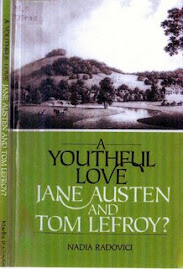
Much has been made of Jane Austen's early love, Tom Lefroy, purportedly wearing a white coat in emulation of Henry Fielding's racy literary hero, Tom Jones. However, the only authority we have for this is Jane herself, who, as a mistress of the art of the double entendre, ought not always to be taken literally. In Jane's earliest surviving letter to Cassandra, we hear that Lefroy:


“has but one fault, which time will, I trust, entirely remove—it is that his morning coat is a great deal too light. He is a very great admirer of Tom Jones, and therefore wears the same coloured clothes, I imagine, as he did when he was wounded.”


In Fielding's novel, Tom Jones incurred his wound in a singular manner: he volunteered to enlist in an army regiment, and in a round of after-dinner toasting and merrymaking, one Ensign Northerton jested about the allegedly loose morals of Jones’ beloved Sophia Western: “Tom French of our regiment had both her and her aunt at Bath” - among several other such slurs on her character. This was too much for Jones, who sprang to her defence, accusing Northerton of being an impudent rascal, which promptly earned him a bottle of liquor hurled at his head. Northerton, it turns out, had heard no such thing of Sophia, but was merely retaliating for an earlier jest by Jones. [Tom Jones, Book VII, Chapter XII]

The point has already been made on this blog that it is likely that an Austen family tradition existed concerning Jane Austen's resemblance to Fielding's heroine, Sophia Western. In Tom Jones, the specific reference to the white coat occurs when Jones is recovering from his injury:


As soon as the sergeant was departed, Jones rose from his bed, and dressed himself entirely, putting on even his coat, which, as its colour was white, showed very visibly streams of blood which had flown down it.[Tom Jones Book VII, Chapter XIV].


Austen biographer Jon Spence has given us a further example of Fielding’s use of wounding as a metaphor for being in love. In what is an extremely convoluted plot, Jones engages in a duel with a Mr Fitzpatrick, who wrongly believes that Jones is consorting with his wife, who is in fact lusting after Jones. Jones nearly kills Fitzpatrick, and is subsequently visited in prison by a Mrs Waters.

Earlier in the novel Mrs Waters had gone to Bath in the company of various Irish gentlemen, including Fitzpatrick, who from then on successfully passed her off as his wife (Fitzpatrick’s real wife was the cousin of Sophia Western). Mrs Waters has also once been in love with Jones:


“It was some time before she discovered that the gentleman [Jones] who had given him [Fitzpatrick] this wound was the very same person from whom her heart had received a wound, which though not of a mortal kind, was yet so deep that it had left a considerable scar behind it.” [Tom Jones Book XVII Chapter IX]

However, judging by the remainder of her interaction with Jones, it is by no means certain that her heart has in fact recovered from its wound.


I have already commented in an earlier post that Tom Lefroy’s purported admiration of Tom Jones need not be taken as incontrovertible fact. Fielding was a known favourite with the Austens, who had previously put on family theatrical performances of at least one of his works (Tom Thumb).

Given the numerous references to characters and situations from Tom Jones throughout Jane Austen’s novels, it is just as likely that it was Jane Austen herself who admired Tom Jones, despite what her brother assured the public after her death, when it became incumbent on the family to start protecting her ladylike reputation. Jane's talk of the Toms Lefroy and Jones and their white coats may well have been was a coded reference for Cassandra’s eyes only.[1]

If so, it would have been by no means the only time that Jane Austen employed a literary reference as a metaphor for her own situation. In a later letter she explicitly likened being stuck at her brother’s house with no means to get home again, to the plight of Fanny Burney’s heroine Camilla, stuck in a summerhouse without a ladder to get out.

Note:
[1] Linda Robinson Walker suggested the idea of a coded reference, although I believe it is more sophisticated than the one she puts forward. Jon Spence (Becoming Jane Austen) has pointed out a few character names from Tom Jones also employed by Jane Austen in her novels, although there are several more that have not been listed by him. One of the most telling examples is perhaps “Willoughby”, a surname from Jane Austen’s maternal ancestors but also the real life Justice Richard Willoughby, who appears in Book VIII, Chapter XI of Tom Jones. Readers of Sense and Sensibility may draw their own conclusions, or not, as they please.

Friday, July 18, 2008

A Spot of Professional Jealousy

I've been reading this edition of James Edward Austen-Leigh's Memoir of Jane Austen while waiting patiently for a copy of the Oxford edition, which has a few extra bells and whistles.

And finally, we discover the reason for Mary Russell Mitford's nastiness about Jane Austen - she was jealous because Jane was a much better writer! James Edward Austen-Leigh writes:

I remember Miss Mitford's saying to me: 'I would almost cut off one of my hands, if it would enable me to write like your aunt with the other.'

Although poor Mr. Austen-Leigh was not at all happy when he read the "prettiest, silliest, most affected husband-hunting butterfly" comments made by Miss Mitford, and was driven to add a postscript to the first edition, denying that his esteemed aunt had been anything of the sort.

I suppose that might show up a difference between Georgian and Victorian sensibilities, and also between Victorian and modern-day sensibilities. Personally I find the description of Jane's lively, youthful personality far more attractive than the impression of a somewhat dour Jane many people have had - until Anne Hathaway's inspired portrayal turned that smartly on its head.

Friday, July 4, 2008

On Women "Seeking Their Fortune"

One of Jane Austen's most intriguing letters was written from Cork St, London in August 1796. Jon Spence has shown that this was the home of Benjamin Langlois, Tom Lefroy's great uncle, with whom Tom lived in London. It is letter no 3. in Deidre Le Faye's Jane Austen's Letters and the text can be found online here at the Republic of Pemberley site.

The relevant passage begins:

Edward & Frank [Jane's brothers] are both gone out to seek their fortunes; the latter is to return soon & help us seek ours.

We must ask to whom is Jane referring in speaking of “us” when her brothers have obviously both gone out? Even more intriguingly, what does she mean by saying that Frank will be returning from seeking his fortune to “help us seek ours”? In her first paragraph describing the journey to London, she uses “I” and “my” repeatedly, so the change to “us” and “ours” once she has arrived is noteworthy. She did not travel to London alone, as subsequent letters make it clear that her brothers would not have countenanced the idea. The “us” must refer to another person present in the Langlois household, apart from Jane and her brothers.

Tom Lefroy is the obvious conclusion, despite Joan Klingel Ray's quite unwarranted assumption, in my view, that he would not have been there. Her statement is based on the fact that Irish law students usually returned home during the long vacation. However, as Lefroy's uncle was a permanent resident of London and highly interested in Tom, his welfare and his education, it is by no means a foregone conclusion that Tom would have been obliged to go home only three weeks into his summer vacation. (Among the many things with which I disagree in this article, I am also unconvinced by Professor Ray's statements about the lengths of the various terms, although will leave that aside for the moment.)

But to return to Jane Austen's letter. To seek one’s fortune in a woman’s case meant to find it through marriage, as is best illustrated by Jane’s own aunt, Philadelphia Austen Hancock. Philadelphia, orphaned by the age of five, at twenty-one elected to become one of the notorious “fishing fleet” – young women who were shipped off to the colonies to catch the husbands they could not catch at home. As Austen biographer Claire Tomalin puts it: “Men went to India to make their fortunes through trade, honest or dishonest, and women went with a somewhat similar object, as everyone knew even if no one said so. Their business was to find a husband, the richer the better, among the Englishmen working there”.

There is a further reference to seeking one's fortune through marriage in Emma, Chapter 40, in a scene set a few days after Harriet's encounter with the gypsies and her "rescue" by Frank Churchill, and where she finally consigns her souvenirs of Mr Elton to the fire. The perennially misguided Emma is now keen to see Harriet get together with Frank Churchill:

'...There it goes, and there is an end, thank Heaven! of Mr Elton.'
'And when,' thought Emma, 'will there be a beginning of Mr Churchill?'
She had soon afterwards reason to believe that the beginning was already made, and could not but hope that the gypsy, though he had told no fortune, might be proved to have made Harriet's.'


References:
Deirdre Le Faye Jane Austen's Letters Oxford University Press, 1997
Joan Klingel Ray The One Sided Romance of Jane Austen and Tom Lefroy Persuasions Online, Vol 28, No. 1 (Winter 2007)
Jon Spence Becoming Jane Austen Continuum International Publishing Group, 2007
Claire Tomalin Jane Austen: A Life Penguin, 2000

Voluptuous Trees & Sexy Shrubbery

As Martin Amis has pointed out (see quote near the header of this blog), the Freudians can have, and have had, a field day with Jane Austen's fiction. Darryl Jones, who himself may or may not subscribe to the Freudian school of thought, has had a great deal of fun with Catherine Morland's exploration of the cabinet and its "cavity of importance" and "place in the middle" alone in her room at night in Northanger Abbey.

But this is not all - what do we make of all the carry-on in Mansfield Park (Chapter 10) concerning gardens and locked gates and Miss Bertram escaping with Henry Crawford into the wilderness beyond, with its oak-covered knoll? Or this deliciously suggestive passage in Chapter 46, where Fanny's

"...eye fell everywhere on lawns and plantations of the freshest green; and the trees, though not fully clothed, were in that delightful state, where farther beauty is known to be at hand, and when, while much is actually given to the sight, more yet remains for the imagination."

Or indeed, is there anything remotely Freudian in Emma in Mr Knightley's encounter with Emma Woodhouse in the garden? "He had followed her into the shrubbery with no idea of trying it."

Or is this blogger just imagining it?

Reference:
Daryl Jones Critical Issues: Jane Austen Palgrave Macmillan 2004

Thursday, July 3, 2008

Some of the most pertinent Austen criticism...

Some critics, at least, got it right:

"[W]hen people compare Shakespeare and Jane Austen, they may mean that the minds of both had consumed all impediments; and for that reason we do not know Jane Austen and we do not know Shakespeare, and for that reason Jane Austen pervades every word that she wrote, and so does Shakespeare."

- Virginia Woolf (1913)


"Jane Austen was born before those bonds which (we are told) protected women from truth, were burst by the Brontes or elaborately untied by George Eliot. Yet the fact remains that Jane Austen knew more about men than either of them. Jane Austen may have been protected from truth: but it was precious little of truth that was protected from her."

- G.K. Chesterton (1913)


"Really, it is time this comic patronage of Jane Austen cased. To believe her limited in range because she was harmonious in method is as sensible as to imagine that when the Atlantic Ocean is as smooth as a mill-pond it shrinks to the size of a mill-pond. There are those who are deluded by the decorousness of her manner... into thinking that she is ignorant of passion. But look through the lattice-work of her neat sentences, joined together with the bright nails of craftsmanship, painted with the gay varnish of wit, and you will see women haggard with desire or triumphant with love, whose delicate reactions to men make the heroines of all our later novelists seem merely to turn signs, "Stop" or "Go" towards the advancing male."

- Rebecca West (1928)


"[Jane Austen's novels] appear to be compact of abject truth. Their events are excruciatingly unimportant; and yet... they will probably outlast all Fielding, Scott, George Eliot, Thackeray and Dickens. The art is so consummate that the secret is hidden; peer at them as hard as one may; shake them; take them apart; one cannot see how it is done."

- Thornton Wilder (1938)

"When a Lady's in the Case"

You know, if one wants to understand the full meaning of the various literary allusions sprinkled throughout Jane Austen's novels and letters, it is not safe to take them at face value, or even to read the critical notes in the back of the book, which invariably gloss over the raciest bits.

As a friend, who is a great Jane Austenite, is fond of saying: Jane was a child of the 18th Century, not the 19th. The 18th Century was far less squeamish in its attitudes than the century that followed. However, Jane published at the start of the 19th, and so very sneakily made a habit of putting in just a snippet of whichever quote suited her purpose, but nearly always left out the pertinent bits, so really one has to go digging and read the whole thing. In the case of Henry Fielding's Tom Jones, this is proving to be a bit of an undertaking, but it's worth it, and not just because of Tom Lefroy's white coat.

The English Department at the University of Toronto has published the full text of John Gay's fable The Hare and Many Friends here, the source of Mrs Elton's "When a Lady's in the Case" quote, and it is well worth perusing.

There is also a nice little analysis of it on the Republic of Pemberley site here.

Some of the stupidest ever Jane Austen criticism...

Amongst a very large selection of way-off-the-mark, downright stupid, truly inane, and sometimes deliberately obtuse and malicious Austen criticism, here are a few little gems from the late 1800s and early 1900s:

"It has always been known that Miss Austen's private life was unruffled by any of the incidents or passions which favour trade of the biographer.. It fits with our idea of the authoress, to find that she was a proficient in the microscopic needlework of sixty years since, that she was never in love..."

- An anonymous review (1870) of James Edward Austen-Leigh's A Memoir of Jane Austen.


"it is scarcely to be expected that books so calm and cold and keen... would ever be popular... They are rather of the class which attracts the connoisseur, which charms the critical and literary mind."

- Margaret Oliphant (1870)


"Every time I read "Pride and Prejudice" I want to dig her up and hit her over the skull with her own shin-bone."

- Mark Twain (1898)


"The key to Jane Austen's fortune with posterity has been in part the extraordinary grace of her facitlity, in fact of her unconsciousness: as if, at the most, for difficulty, for embarrassment, she sometimes over her work basket...fell... into woolgathering, and her dropped stitches... were afterwards picked up as... little master-strokes of imagination."

- Henry James (1905)

(With acknowledgement to Karen Joy Fowler, author of The Jane Austen Book Club, who compiled a collection of Austen criticism from the 19th century to the present, and included it as an appendix to her novel. Fascinating stuff! Jane Austen is clearly something of a Rorschach Test - she can be everything and anything that the critic wants her to be.)

Wednesday, June 25, 2008

Jane Fairfax is "a riddle, quite a riddle"

Having, dear fellow bloggers, finally finished reading Emma about 30 years after having started it, I can only say that I am grateful I did not finish it back in those early days, as most of the subtleties would have gone straight over my head.

A couple of days ago, I decided to apply myself to Arnie Perlstein's fascinating series of questions about the novel (particularly those about the somewhat vexed relationship between Frank Churchill and Jane Fairfax), to see how many of them I could answer. Initially, the response was "not many", which necessitated another reading, and what an eye opener it was!

Although a few of Arnie's ingenious questions still remain unanswered by this blogger at least, I think I can safely say that 1) Jane Fairfax is now much less of a riddle than she proved to be previously, 2) Frank Churchill is indeed, as Arnie says, a "master manipulator", and 3) Jane Austen gets naughtier and naughtier on every reading! :)

Monday, June 16, 2008

Mr Woodhouse & "Kitty, a Fair But Frozen Maid"

In Emma, Jane Austen makes much use of riddles and games. The riddle given by Mr Woodhouse, of which he could only remember the first few lines, follows in full.

Kitty, a fair, but frozen maid,
Kindled a flame I still deplore;
The hood-wink'd boy I call'd in aid,
Much of his near approach afraid,
So fatal to my suit before.

At length, propitious to my pray'r,
The little urchin came;
At once he sought the midway air,
And soon he clear'd, with dextrous care,
The bitter relicks of my flame.

To Kitty, Fanny now succeeds,
She kindles slow, but lasting fires:
With care my appetite she feeds;
Each day some willing victim bleeds,
To satisfy my strange desires.

Say, by what title, or what name,
Must I this youth address?
Cupid and he are not the same,
Tho' both can raise, or quench a flame --
I'll kiss you, if you guess.

The "official" (although entirely unconvincing), answer to the riddle is a chimneysweep. However, modern critics including Susan Allen Ford have found far racier interpretations:

'Mr. Woodhouse’s offering for Harriet’s collection, “Kitty, a fair but frozen maid,” a 1771 riddle by David Garrick, also flirts with sexual mischief (in this case syphilis and sodomy) before ending in an “innocent” answer.'

Daryl Jones acknowledges Jill Heydt-Stevenson's reading of this riddle as an hilarious possibile explanation for Mr Woodhouse's delicate health, although not quite corresponding with his own reading of Mr W., who he sees as an entirely sexless being. (Perhaps he was an incorrigible rake in his youth and is now paying the price?) Jones also points out that Mr Woodhouse is inordinately fond of thin gruel as the only wholesome food for supper - gruel at that time being one of the purported remedies for syphilis!

Susan Allen Ford "Reading Elegant Extracts in Emma: Very Entertaining" Persuasions Online, Volume 28, NO.1 (Winter 2007)
Darryl Jones Critical Issues: Jane Austen, Palgrave, 2004.

Wednesday, June 11, 2008

Jane Austen & "Sophia Sentiment"

On the posthumous publication of Persuasion and Northanger Abbey, Jane’s favourite brother Henry Austen described her physical appearance thus: “It might with truth be said, that her eloquent blood spoke through her modest cheek.” As Marghanita Laski points out, this is an incredibly pompous-sounding tribute - until we realise that these same words, originally from the poet John Donne, are quoted by Henry Fielding in Tom Jones to describe Sophia Western, who finally marries Jones - “Her pure and eloquent blood spoke in her cheeks”.[1]

Furthermore, Sophia Western’s complexion “had rather more of the lily than the rose; but when exercise, or modesty [emphasis added] increased her natural colour, no vermilion could equal it.” Sophia’s eyes were very dark and her black hair was “so luxuriant that it reached her middle, before she cut it to comply with modern fashion”. Louisa Austen’s description of her aunt Jane is as follows: “large dark eyes and a brilliant complexion, and long, long black hair down to her knees”[2]

From here, we may need to take another look at the “Sophia Sentiment” who wrote to James Austen’s publication The Loiterer on 28 March 1789. Some critics have already suggested that “Sophia Sentiment” was Jane Austen. Claire Tomalin does not, on the grounds that “Miss Sentiment” deplores women’s taste in literature. However, soon after this, Jane Austen uses Sophia for the heroine’s name in her satire Love and Freindship, [sic] attacking the excesses of the romantic novel, a favourite Austen theme. Tomalin suggests that repeated use of the name Sophia may have been a running family joke.[3] If this is the case, which seems likely, it is not hard to imagine where the joke originated.

Notes

[1] Marghanita Laski: Jane Austen & Her World; Henry Fielding, Tom Jones Book IV, Chapter II; John Donne (1572-1631) “Of the Progress of the Soul: the Second Anniversary” (notes to Tom Jones, Oxford University Press edition).
[2] Henry Fielding, Tom Jones Book IV, Chapter II;.Claire Tomalin, Jane Austen: A Life pp 108 & 311
[3] Claire Tomalin, pp 63 & 303-4.

Tuesday, June 10, 2008

Emma

Let's start off this blog with some musings about Emma, stimulated by the recent run on ABC television of the Emmy-winning 1996 adaptation starring Kate Beckinsale.

The novel, I must abjectly confess to my sister Janeites, I have been attempting to read for the past 30 years, without actually ever managing to make it to the end. However, this time we have great hopes that we will actually get there. But don't you just hate Mr Woodhouse? I want to slap some sense into the man, and every time he appears on the page, I am tempted to throw the book across the room (I must confess to feeling slightly guilty about this).

However, recently, I've been reading a splendid book of Austen criticism by Darryl Jones, Professor of English literature at Trinity College, Dublin. The book is Critical Issues: Jane Austen, Palgrave, 2004.

This is what he has to say about Mr Woodhouse - "Decades of reading, studying, teaching and writing about Jane Austen have only served to strengthen my sense that, far from a cherishably comic character, Mr Woodhouse is a pampered, whingeing, cretinous leech - a one-man justification for the class war and literature's best advert for compulsory euthanasia. In fact I'd happily kill him myself, given the chance."

Hear, hear Dr Jones, hear hear!