"Pictures of perfection, as you know, make me sick & wicked"

- Jane Austen
"Jane Austen is weirdly capable of keeping everybody busy. The moralists, the Eros-and-Agape people, the Marxists, the Freudians, the Jungians, the semioticians, the deconstructors - all find an adventure playground in six samey novels about middle-class provincials. And for every generation of critics, and readers, her fiction effortlessly renews itself."

- Martin Amis, in The New Yorker


Showing posts with label Emma. Show all posts

Monday, August 4, 2008

Austen Autobiographical? "Emma"

Jane Austen, writing to Cassandra about Tom Lefroy, 9 January 1796:

You scold me so much in the nice long letter which I have this moment received from you, that I am almost afraid to tell you how my Irish friend and I behaved. Imagine to yourself everything most profligate and shocking in the way of dancing and sitting down together.


Emma Woodhouse, trying to decide whether she really is in love with Frank Churchill, and whether she can mention his name without embarrassing herself:

"Now, how am I going to introduce him? Am I unequal to speaking his name at once before all these people? Is it necessary for me to use any roundabout phrase? Your Yorkshire friend -- your correspondent in Yorkshire; -- that would be the way, I suppose, if I were very bad. No, I can pronounce his name without the smallest distress. I certainly get better and better. Now for it."


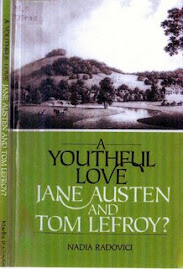
There is a further link, as Tom Lefroy's brother Anthony was based in York. See Tracking Tom Lefroy and His nephew at Becoming Jane Fansite for more information on the York branch of the Lefroy family.

Friday, July 4, 2008

On Women "Seeking Their Fortune"

One of Jane Austen's most intriguing letters was written from Cork St, London in August 1796. Jon Spence has shown that this was the home of Benjamin Langlois, Tom Lefroy's great uncle, with whom Tom lived in London. It is letter no 3. in Deidre Le Faye's Jane Austen's Letters and the text can be found online here at the Republic of Pemberley site.

The relevant passage begins:

Edward & Frank [Jane's brothers] are both gone out to seek their fortunes; the latter is to return soon & help us seek ours.

We must ask to whom is Jane referring in speaking of “us” when her brothers have obviously both gone out? Even more intriguingly, what does she mean by saying that Frank will be returning from seeking his fortune to “help us seek ours”? In her first paragraph describing the journey to London, she uses “I” and “my” repeatedly, so the change to “us” and “ours” once she has arrived is noteworthy. She did not travel to London alone, as subsequent letters make it clear that her brothers would not have countenanced the idea. The “us” must refer to another person present in the Langlois household, apart from Jane and her brothers.

Tom Lefroy is the obvious conclusion, despite Joan Klingel Ray's quite unwarranted assumption, in my view, that he would not have been there. Her statement is based on the fact that Irish law students usually returned home during the long vacation. However, as Lefroy's uncle was a permanent resident of London and highly interested in Tom, his welfare and his education, it is by no means a foregone conclusion that Tom would have been obliged to go home only three weeks into his summer vacation. (Among the many things with which I disagree in this article, I am also unconvinced by Professor Ray's statements about the lengths of the various terms, although will leave that aside for the moment.)

But to return to Jane Austen's letter. To seek one’s fortune in a woman’s case meant to find it through marriage, as is best illustrated by Jane’s own aunt, Philadelphia Austen Hancock. Philadelphia, orphaned by the age of five, at twenty-one elected to become one of the notorious “fishing fleet” – young women who were shipped off to the colonies to catch the husbands they could not catch at home. As Austen biographer Claire Tomalin puts it: “Men went to India to make their fortunes through trade, honest or dishonest, and women went with a somewhat similar object, as everyone knew even if no one said so. Their business was to find a husband, the richer the better, among the Englishmen working there”.

There is a further reference to seeking one's fortune through marriage in Emma, Chapter 40, in a scene set a few days after Harriet's encounter with the gypsies and her "rescue" by Frank Churchill, and where she finally consigns her souvenirs of Mr Elton to the fire. The perennially misguided Emma is now keen to see Harriet get together with Frank Churchill:

'...There it goes, and there is an end, thank Heaven! of Mr Elton.'
'And when,' thought Emma, 'will there be a beginning of Mr Churchill?'
She had soon afterwards reason to believe that the beginning was already made, and could not but hope that the gypsy, though he had told no fortune, might be proved to have made Harriet's.'


References:
Deirdre Le Faye Jane Austen's Letters Oxford University Press, 1997
Joan Klingel Ray The One Sided Romance of Jane Austen and Tom Lefroy Persuasions Online, Vol 28, No. 1 (Winter 2007)
Jon Spence Becoming Jane Austen Continuum International Publishing Group, 2007
Claire Tomalin Jane Austen: A Life Penguin, 2000

Voluptuous Trees & Sexy Shrubbery

As Martin Amis has pointed out (see quote near the header of this blog), the Freudians can have, and have had, a field day with Jane Austen's fiction. Darryl Jones, who himself may or may not subscribe to the Freudian school of thought, has had a great deal of fun with Catherine Morland's exploration of the cabinet and its "cavity of importance" and "place in the middle" alone in her room at night in Northanger Abbey.

But this is not all - what do we make of all the carry-on in Mansfield Park (Chapter 10) concerning gardens and locked gates and Miss Bertram escaping with Henry Crawford into the wilderness beyond, with its oak-covered knoll? Or this deliciously suggestive passage in Chapter 46, where Fanny's

"...eye fell everywhere on lawns and plantations of the freshest green; and the trees, though not fully clothed, were in that delightful state, where farther beauty is known to be at hand, and when, while much is actually given to the sight, more yet remains for the imagination."

Or indeed, is there anything remotely Freudian in Emma in Mr Knightley's encounter with Emma Woodhouse in the garden? "He had followed her into the shrubbery with no idea of trying it."

Or is this blogger just imagining it?

Reference:
Daryl Jones Critical Issues: Jane Austen Palgrave Macmillan 2004

Thursday, July 3, 2008

Anna Austen Lefroy had read her "Emma"

Here we have Jane Austen's niece, Anna Austen Lefroy (pictured at left) writing to her own niece, Emma Austen-Leigh, on 24 May 1869, on the subject of the Jane Austen-Tom Lefroy romance:


"I am the only person who has any faith in the tradition – nor should I probably be an exception if I had not married into the family of Lefroy – but when I came to hear again & again, from those who were old enough to remember, how the Mother had disliked Tom Lefroy because he had behaved so ill to Jane Austen, which sometimes the additional weight of the Father’s condemnation, what could I think then? Or what except to give a verdict… [of] ‘under mitigating circumstances’ – As – First, the youth of the Parties – secondly, that Mrs. Lefroy, charming woman as she was, & warm in her feelings, was also partial in her judgments – Thirdly – that for other causes, too long to enter upon, she not improbably set out with a prejudice against the Gentleman, & would have distrusted had there been no Jane Austen in the case. The one thing certain is, that to the last year of his life she was remembered as the object of his youthful admiration."
[emphasis in bold added]

Compare this to Jane Austen's character Mr Knightley, discussing Frank Churchill with Emma Woodhouse, in Emma, chapter 51:

"I was not quite impartial in my judgement, Emma; but yet, I think had you not been in the case, I should still have distrusted him."
[emphasis in bold added]

"When a Lady's in the Case"

You know, if one wants to understand the full meaning of the various literary allusions sprinkled throughout Jane Austen's novels and letters, it is not safe to take them at face value, or even to read the critical notes in the back of the book, which invariably gloss over the raciest bits.

As a friend, who is a great Jane Austenite, is fond of saying: Jane was a child of the 18th Century, not the 19th. The 18th Century was far less squeamish in its attitudes than the century that followed. However, Jane published at the start of the 19th, and so very sneakily made a habit of putting in just a snippet of whichever quote suited her purpose, but nearly always left out the pertinent bits, so really one has to go digging and read the whole thing. In the case of Henry Fielding's Tom Jones, this is proving to be a bit of an undertaking, but it's worth it, and not just because of Tom Lefroy's white coat.

The English Department at the University of Toronto has published the full text of John Gay's fable The Hare and Many Friends here, the source of Mrs Elton's "When a Lady's in the Case" quote, and it is well worth perusing.

There is also a nice little analysis of it on the Republic of Pemberley site here.

Wednesday, June 25, 2008

Jane Fairfax is "a riddle, quite a riddle"

Having, dear fellow bloggers, finally finished reading Emma about 30 years after having started it, I can only say that I am grateful I did not finish it back in those early days, as most of the subtleties would have gone straight over my head.

A couple of days ago, I decided to apply myself to Arnie Perlstein's fascinating series of questions about the novel (particularly those about the somewhat vexed relationship between Frank Churchill and Jane Fairfax), to see how many of them I could answer. Initially, the response was "not many", which necessitated another reading, and what an eye opener it was!

Although a few of Arnie's ingenious questions still remain unanswered by this blogger at least, I think I can safely say that 1) Jane Fairfax is now much less of a riddle than she proved to be previously, 2) Frank Churchill is indeed, as Arnie says, a "master manipulator", and 3) Jane Austen gets naughtier and naughtier on every reading! :)

Monday, June 16, 2008

Mr Woodhouse & "Kitty, a Fair But Frozen Maid"

In Emma, Jane Austen makes much use of riddles and games. The riddle given by Mr Woodhouse, of which he could only remember the first few lines, follows in full.

Kitty, a fair, but frozen maid,
Kindled a flame I still deplore;
The hood-wink'd boy I call'd in aid,
Much of his near approach afraid,
So fatal to my suit before.

At length, propitious to my pray'r,
The little urchin came;
At once he sought the midway air,
And soon he clear'd, with dextrous care,
The bitter relicks of my flame.

To Kitty, Fanny now succeeds,
She kindles slow, but lasting fires:
With care my appetite she feeds;
Each day some willing victim bleeds,
To satisfy my strange desires.

Say, by what title, or what name,
Must I this youth address?
Cupid and he are not the same,
Tho' both can raise, or quench a flame --
I'll kiss you, if you guess.

The "official" (although entirely unconvincing), answer to the riddle is a chimneysweep. However, modern critics including Susan Allen Ford have found far racier interpretations:

'Mr. Woodhouse’s offering for Harriet’s collection, “Kitty, a fair but frozen maid,” a 1771 riddle by David Garrick, also flirts with sexual mischief (in this case syphilis and sodomy) before ending in an “innocent” answer.'

Daryl Jones acknowledges Jill Heydt-Stevenson's reading of this riddle as an hilarious possibile explanation for Mr Woodhouse's delicate health, although not quite corresponding with his own reading of Mr W., who he sees as an entirely sexless being. (Perhaps he was an incorrigible rake in his youth and is now paying the price?) Jones also points out that Mr Woodhouse is inordinately fond of thin gruel as the only wholesome food for supper - gruel at that time being one of the purported remedies for syphilis!

Susan Allen Ford "Reading Elegant Extracts in Emma: Very Entertaining" Persuasions Online, Volume 28, NO.1 (Winter 2007)
Darryl Jones Critical Issues: Jane Austen, Palgrave, 2004.

Tuesday, June 10, 2008

Emma

Let's start off this blog with some musings about Emma, stimulated by the recent run on ABC television of the Emmy-winning 1996 adaptation starring Kate Beckinsale.

The novel, I must abjectly confess to my sister Janeites, I have been attempting to read for the past 30 years, without actually ever managing to make it to the end. However, this time we have great hopes that we will actually get there. But don't you just hate Mr Woodhouse? I want to slap some sense into the man, and every time he appears on the page, I am tempted to throw the book across the room (I must confess to feeling slightly guilty about this).

However, recently, I've been reading a splendid book of Austen criticism by Darryl Jones, Professor of English literature at Trinity College, Dublin. The book is Critical Issues: Jane Austen, Palgrave, 2004.

This is what he has to say about Mr Woodhouse - "Decades of reading, studying, teaching and writing about Jane Austen have only served to strengthen my sense that, far from a cherishably comic character, Mr Woodhouse is a pampered, whingeing, cretinous leech - a one-man justification for the class war and literature's best advert for compulsory euthanasia. In fact I'd happily kill him myself, given the chance."

Hear, hear Dr Jones, hear hear!