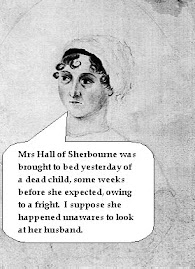
"Pictures of perfection, as you know, make me sick & wicked"

- Jane Austen
"Jane Austen is weirdly capable of keeping everybody busy. The moralists, the Eros-and-Agape people, the Marxists, the Freudians, the Jungians, the semioticians, the deconstructors - all find an adventure playground in six samey novels about middle-class provincials. And for every generation of critics, and readers, her fiction effortlessly renews itself."

- Martin Amis, in The New Yorker


Showing posts with label Tom Jones. Show all posts

Wednesday, July 30, 2008

Did Tom Lefroy Really Wear A White Coat?

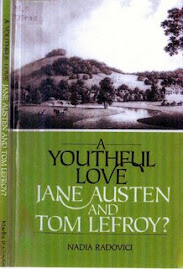
Much has been made of Jane Austen's early love, Tom Lefroy, purportedly wearing a white coat in emulation of Henry Fielding's racy literary hero, Tom Jones. However, the only authority we have for this is Jane herself, who, as a mistress of the art of the double entendre, ought not always to be taken literally. In Jane's earliest surviving letter to Cassandra, we hear that Lefroy:


“has but one fault, which time will, I trust, entirely remove—it is that his morning coat is a great deal too light. He is a very great admirer of Tom Jones, and therefore wears the same coloured clothes, I imagine, as he did when he was wounded.”


In Fielding's novel, Tom Jones incurred his wound in a singular manner: he volunteered to enlist in an army regiment, and in a round of after-dinner toasting and merrymaking, one Ensign Northerton jested about the allegedly loose morals of Jones’ beloved Sophia Western: “Tom French of our regiment had both her and her aunt at Bath” - among several other such slurs on her character. This was too much for Jones, who sprang to her defence, accusing Northerton of being an impudent rascal, which promptly earned him a bottle of liquor hurled at his head. Northerton, it turns out, had heard no such thing of Sophia, but was merely retaliating for an earlier jest by Jones. [Tom Jones, Book VII, Chapter XII]

The point has already been made on this blog that it is likely that an Austen family tradition existed concerning Jane Austen's resemblance to Fielding's heroine, Sophia Western. In Tom Jones, the specific reference to the white coat occurs when Jones is recovering from his injury:


As soon as the sergeant was departed, Jones rose from his bed, and dressed himself entirely, putting on even his coat, which, as its colour was white, showed very visibly streams of blood which had flown down it.[Tom Jones Book VII, Chapter XIV].


Austen biographer Jon Spence has given us a further example of Fielding’s use of wounding as a metaphor for being in love. In what is an extremely convoluted plot, Jones engages in a duel with a Mr Fitzpatrick, who wrongly believes that Jones is consorting with his wife, who is in fact lusting after Jones. Jones nearly kills Fitzpatrick, and is subsequently visited in prison by a Mrs Waters.

Earlier in the novel Mrs Waters had gone to Bath in the company of various Irish gentlemen, including Fitzpatrick, who from then on successfully passed her off as his wife (Fitzpatrick’s real wife was the cousin of Sophia Western). Mrs Waters has also once been in love with Jones:


“It was some time before she discovered that the gentleman [Jones] who had given him [Fitzpatrick] this wound was the very same person from whom her heart had received a wound, which though not of a mortal kind, was yet so deep that it had left a considerable scar behind it.” [Tom Jones Book XVII Chapter IX]

However, judging by the remainder of her interaction with Jones, it is by no means certain that her heart has in fact recovered from its wound.


I have already commented in an earlier post that Tom Lefroy’s purported admiration of Tom Jones need not be taken as incontrovertible fact. Fielding was a known favourite with the Austens, who had previously put on family theatrical performances of at least one of his works (Tom Thumb).

Given the numerous references to characters and situations from Tom Jones throughout Jane Austen’s novels, it is just as likely that it was Jane Austen herself who admired Tom Jones, despite what her brother assured the public after her death, when it became incumbent on the family to start protecting her ladylike reputation. Jane's talk of the Toms Lefroy and Jones and their white coats may well have been was a coded reference for Cassandra’s eyes only.[1]

If so, it would have been by no means the only time that Jane Austen employed a literary reference as a metaphor for her own situation. In a later letter she explicitly likened being stuck at her brother’s house with no means to get home again, to the plight of Fanny Burney’s heroine Camilla, stuck in a summerhouse without a ladder to get out.

Note:
[1] Linda Robinson Walker suggested the idea of a coded reference, although I believe it is more sophisticated than the one she puts forward. Jon Spence (Becoming Jane Austen) has pointed out a few character names from Tom Jones also employed by Jane Austen in her novels, although there are several more that have not been listed by him. One of the most telling examples is perhaps “Willoughby”, a surname from Jane Austen’s maternal ancestors but also the real life Justice Richard Willoughby, who appears in Book VIII, Chapter XI of Tom Jones. Readers of Sense and Sensibility may draw their own conclusions, or not, as they please.

Wednesday, July 9, 2008

What They Said About Her: Henry Austen

This is what Jane's favourite brother Henry wrote about her, in his "Biographical Notice of the Author", which accompanied the posthumously published (1818) Northanger Abbey and Persuasion.

"Of personal attractions she possessed a considerable share. Her stature was that of true elegance. It could not have been increased without exceeding the middle height. Her carriage and deportment were quiet, yet graceful. Her features were separately good. Their assemblage produced an unrivalled expression of that cheerfulness, sensibility, and benevolence, which were her real characteristics. Her complexion was of the finest texture. It might with truth be said, that her eloquent blood spoke through her modest cheek. Her voice was extremely sweet. She delivered herself with fluency and precision. Indeed she was formed for elegant and rational society, excelling in conversation as much as in composition."

It has been noted that part of Henry's description - "her eloquent blood spoke through her modest cheek" - owes a debt to the poet John Donne, and consequently to Henry Fielding, who employed the same passage in Tom Jones (see my earlier post on this blog: Jane Austen & "Sophia Sentiment").

However, in the same Biographical Notice, Henry (at left) also avows that his sister had her reservations about Fielding. This latter assertion needs to be taken with a large grain of salt, considering the references in Jane's letters and the themes and character names used by her that also appear in Tom Jones. (A few of these have been pointed out by Jon Spence in Becoming Jane Austen, although a diligent reader will discover plenty more that he did not specifically note.)

Re-reading the famous Tom Lefroy white coat reference will reveal that the similarity to Jones is one envisaged by Jane Austen, not one that Lefroy himself professed or was necessarily aware of. "He is a very great admirer of Tom Jones, and therefore wears the same coloured clothes, I imagine, which he did when he was wounded." (Jane to Cassandra, 9 January 1796, emphasis in bold added).


Henry Austen's tribute to his deceased sister can therefore be considered the first of many attempts by her relatives to whitewash her image, whereby the sharp and witty Jane Austen becomes transformed into that sanctimonious creature, Saint Jane. Personally, this blogger much prefers the Jane whose halo is just ever so slightly askew!

Thursday, July 3, 2008

"When a Lady's in the Case"

You know, if one wants to understand the full meaning of the various literary allusions sprinkled throughout Jane Austen's novels and letters, it is not safe to take them at face value, or even to read the critical notes in the back of the book, which invariably gloss over the raciest bits.

As a friend, who is a great Jane Austenite, is fond of saying: Jane was a child of the 18th Century, not the 19th. The 18th Century was far less squeamish in its attitudes than the century that followed. However, Jane published at the start of the 19th, and so very sneakily made a habit of putting in just a snippet of whichever quote suited her purpose, but nearly always left out the pertinent bits, so really one has to go digging and read the whole thing. In the case of Henry Fielding's Tom Jones, this is proving to be a bit of an undertaking, but it's worth it, and not just because of Tom Lefroy's white coat.

The English Department at the University of Toronto has published the full text of John Gay's fable The Hare and Many Friends here, the source of Mrs Elton's "When a Lady's in the Case" quote, and it is well worth perusing.

There is also a nice little analysis of it on the Republic of Pemberley site here.

Wednesday, June 11, 2008

Jane Austen & "Sophia Sentiment"

On the posthumous publication of Persuasion and Northanger Abbey, Jane’s favourite brother Henry Austen described her physical appearance thus: “It might with truth be said, that her eloquent blood spoke through her modest cheek.” As Marghanita Laski points out, this is an incredibly pompous-sounding tribute - until we realise that these same words, originally from the poet John Donne, are quoted by Henry Fielding in Tom Jones to describe Sophia Western, who finally marries Jones - “Her pure and eloquent blood spoke in her cheeks”.[1]

Furthermore, Sophia Western’s complexion “had rather more of the lily than the rose; but when exercise, or modesty [emphasis added] increased her natural colour, no vermilion could equal it.” Sophia’s eyes were very dark and her black hair was “so luxuriant that it reached her middle, before she cut it to comply with modern fashion”. Louisa Austen’s description of her aunt Jane is as follows: “large dark eyes and a brilliant complexion, and long, long black hair down to her knees”[2]

From here, we may need to take another look at the “Sophia Sentiment” who wrote to James Austen’s publication The Loiterer on 28 March 1789. Some critics have already suggested that “Sophia Sentiment” was Jane Austen. Claire Tomalin does not, on the grounds that “Miss Sentiment” deplores women’s taste in literature. However, soon after this, Jane Austen uses Sophia for the heroine’s name in her satire Love and Freindship, [sic] attacking the excesses of the romantic novel, a favourite Austen theme. Tomalin suggests that repeated use of the name Sophia may have been a running family joke.[3] If this is the case, which seems likely, it is not hard to imagine where the joke originated.

Notes

[1] Marghanita Laski: Jane Austen & Her World; Henry Fielding, Tom Jones Book IV, Chapter II; John Donne (1572-1631) “Of the Progress of the Soul: the Second Anniversary” (notes to Tom Jones, Oxford University Press edition).
[2] Henry Fielding, Tom Jones Book IV, Chapter II;.Claire Tomalin, Jane Austen: A Life pp 108 & 311
[3] Claire Tomalin, pp 63 & 303-4.